In my childhood, my dad always seemed like a quiet enigma. As a result, I was always looking for insight about what he liked, found funny or interesting. A curiosity that stayed with me as I aged. I was happy when he took an interest in things I enjoyed. “Hey, how is that show so good? Who writes it?” he once asked me about Breaking Bad. “It’s a guy who wrote for the X-Files,” I told him. “Oh, well that makes sense!” he declared.
My dad was a lot like one of the characters from that show, Mike Ehrmantraut. They both had a confident silence and they weren’t in a hurry nor would anything ever make them jump. Jon also reported that he possessed the same intimidating stare of Paul Sorvino. As he got older he looked a lot like the character, Bill Tench from Mindhunter, to the point that watching that show was mildly comforting as if I was seeing him again. The same generational stern manner to match.
He never acted like a deeply complicated person at all. He was self-professed, “not artistic,” but had an affinity for artistic things. He loved movies. He marveled at how glorious of an experience the movie Alien was, before the time of trailers that showed you everything that would happen. “I had no idea what that movie was going to be about. We went in, and man…” he’d say with as much appreciation as the day he saw it. The same with the Godfather, I can’t watch part two without thinking of my dad. At the end when Michael closes the door on Kay, I can always hear my dad saying, “That’s the coldest thing I’ve ever seen in a movie.”
He was amused at my selection of movies as well. I would play him things I liked, Michel Gondry music videos, Rushmore, an Icelandic film called Noi Albinnoi and Goodbye Lenin! Watching Virgin Suicides, my sister and I snickered at the silent communication going on around a boy, trapped on a family date. Then my dad said, “Yea, there’s the dad. He doesn’t know what the hell is going on.”
One night I put on Monsoon Wedding, a favorite of mine. As a young person, I hadn’t fully connected to the emotional weight of some of the situations. In one scene, a father asks a close friend to leave in defense and protection of a loved one. My dad was deeply moved by this scene, his face was transfixed, “Would you be able to do that?” For some reason, it affected him. These slices of my dad’s emotional side would come through like flashes of lightning in passing clouds. They always caught me off guard and became pieces of a puzzle I could never finish.
•
My dad was not like most people or parents I knew. His whole life was hard work, even as a child, it’s all he did. If you’re a migrant worker as a child, I’d say you probably didn’t have a childhood. Our generational gap and his trauma made him hard for me to understand. I think he knew he was distant and felt bad about it but didn’t really know how to stop.
The stress of his job made him even harder to reach. He was at work so much or exhausted that all I had were the little things. The trips to get fast food, going to the store together, watching movies, talking about space, those were my favorite moments. The incredibly ordinary and mundane moments were the most valuable.
On occasion he would blast his collection of music. Otis Redding, the Everly Brothers, Marvin Gaye, Roy Orbison, Creedence Clearwater or Patsy Cline. Every so often he would mention an appreciation for modern music, like Prince, which was far too hip for him. When Doves Cry succeeded at capturing a quiet ache to him, professing it to be a great song.
On the morning of his anniversary when I was about ten, he awoke in a cheerful mood and turned on the stereo. My sister’s CD started playing the Cure, Friday I’m In Love, “Who is this? This is a great band!” He thought it was amazing, my sister and I died laughing.

One of my earliest and faintest memories was being up late and his reel to reel playing Bad Moon Rising. Like most men of his age and of the south, he loved Creedence. He absolutely loved Midnight Special. I don’t know if he ever knew that the song was from an old folk song. “They’re singing about Houston!” he exclaimed with a grin. I wish I could have told him that the Midnight Special was about a passenger train in Houston, whose passing light would shine into the cells of the prison at night. The light was a symbol of hope, of freedom beyond all that darkness to each prisoner who could see it. He would have loved knowing that. I don’t think he did, we never got a chance to talk about it.
•
As I entered junior high, my dad’s drinking got worse with the stress of his work being put in a new department. At least I think anyway, who knows. When I was in 7th grade I had an art project where we made a collage from a cartoon strip character. I picked Grim, the yellow dog from Mother Goose and Grimm. I studied his shape carefully, meticulously recreating his giant nose and body proportions. It was actually impressive how it turned out and I was feeling proud.
I brought it home and left it on the little table by his chair. Maybe I was hoping that he would say something. He didn’t notice or if he did, he didn’t care. Later on in the night I saw his trademark drink sitting on top of it. The glass, filled with a mix of J&B and 7up. The ice sending condensation down the glass onto my perfectly constructed Grim. The black construction paper bled into the neighboring yellow. An immense amount of pain winced through me and I rescued it the moment he wasn’t in the room. I stared at the collage and prepared myself for a life filled with things no one else would care about. but I was still disappointed, I had hoped that he would like it, be able to see the amount of time and attention it had taken me. I didn’t bother trying to show him any other work for a long time after that.
There were plenty of other artistic things that I made that my dad was proud of. I don’t remember that specific terrible moment because I like to feel sad. I remember it because it signaled the peak of his drinking he was about to approach. It was out of control, building up in those following years and that was one of many signals. I don’t think he thought he had a problem but his behavior was contradictory.
He didn’t have a drinking problem that he ever admitted to but he kept the liquor in the garage away from us. It was always eerie to me that the bottle stayed in a cabinet in the garage, hidden. It felt like equal parts of hiding it from us and himself. It wasn’t locked up but it might as have well been. In a lot of ways it’s how I felt about him, he was always locked up away from us.
My feelings towards my dad suffered as I grew up. By middle school, our relationship wasn’t the same. I began to resent him for all the flaws I could fully see. It seemed like we had little to talk about during my high school years. There was an awkward shift. Our bond suffered. I was depressed, unfocused, and rebellious. I made shit grades, failed a class twice, and in general added stress to his life, although he often returned the favor.
His drinking made the house feel miserable. You never knew the energy or personality that would come out during those few night binges of the month. It wasn’t fun. I dreaded them. After the age of ten I gave up trying to make believe it was pleasant. I didn’t like my dad’s drinking persona. It wasn’t the same. It wasn’t real. He unfortunately thought it made him more sociable and relaxed. By the time I got to sixth grade the jovial drinking times were scarce. He was mainly unleashing endless frustrations about work and everything in between. I avoided the living room after 9pm.
•
As I entered high school my rebellion came out in depression with bits of anxiety. To him, my problems had nothing to do with him or our household secrets. I hated that he never knew how to help me, only assumed the worst about me. At that time he was a dictator to me, someone who I didn’t want to be, or be around. My high school years were painful, filled with mistakes and confusion.
One winter afternoon, I had fallen asleep on the couch, a space heater sending me into a warm coma. My dad returned home from work, irritated about something and began to yell at me from the kitchen. As I struggled to wake up and hear what he’d asked, he stared at me in disgust. In hostility, he hurled an accusation, “Are you on drugs?” Half-awake, I blinked in hurt absurdity.


These abrasive moments sometimes fueled a deep hate towards him. By my senior year, things finally tempered and we had reached a peaceful state once again. My mom had to lecture him about what his attitude was doing to my mental health after finding out that I was hurting myself to cope with everything. Things had slowly changed, relaxed a bit. I guess maybe it was also the reality that I was getting to the age where I had the ability to leave if I chose to. He didn’t want to fight with me about anything anymore. Maybe he realized he didn’t know what I was feeling since I hid things as much as he did.
•
During my first year at college I was wasting energy in a terrible relationship. It was a side effect of growing up in an environment that seemed to tell me: relationships are supposed to be painful and hiding bad things is normal. I thought devoting yourself to the problems shows how much you love the person. Needless to say, the relationship had run me down. I’d been forcing a smile to prevent my family from knowing, worrying, or passing any judgements onto the person they had loved too.
The day before Christmas my dad had plans to make gumbo, our shared holiday favorite. I was tired from my crappy retail job and not a morning person to begin with. He cheerfully asked if I wanted to go to the Asian grocery store with him for supplies. I didn’t want to back down on our tradition so I scraped myself together. My sister made a harmless crack about how miserable I looked, crabby and tired. In the car, on the way to the store, I started to cry. I stared out the window, trying desperately to stop being upset only to fail more with each second. I never wanted my parents to see me upset, I don’t know why.
In the thirty-minute drive, we didn’t speak. My dad never noticed that it wasn’t our usual silence. My mental break had not stopped, it was beyond my control. When we got to the store I couldn’t hide it anymore. I finally faced him, sobbing uncontrollably. He was perplexed. I tried to reassure him I was fine and just tired. I elected to stay in the car. His face unguarded and confused at the emotional outburst, studied me for a moment, looked out the window and then accepted my deal. After he left, I sobbed months’ worth of sadness, frustration, and pain onto the same seat I laid on during all of our family trips. Then I cleaned myself up and we would both go on to pretend that nothing had happened.
When he came back he gave me a fresh baguette in a way that reminded me of the chocolate pudding he got me the day I came home crying after getting pushed and scraped up. He knew within hours, maybe minutes what was bothering me. He could put it together, in a way I didn’t realize back then. The person in my life that my dad had thought was a good thing, was not. He knew my behavior that day meant things were far from alright. Years later my mom told me around that occasion he had said, “I don’t want a person making her upset all the time, she doesn’t need that shit.”
•
That tan Astro van was some sort of Bermuda triangle of varying moments. On one of the worst days of his life, or so he claimed, the van had broken down, in pouring rain on Bay Area Blvd, during rush hour. Soaking wet, he had managed to get the car to the gas station nearby, the Stop N Go. The rain finally ended as he sat and waited for a rental car. A couple of kids from apartments across the street began driving by on their bikes, asking him questions. “Hey mister! Did your car break down?” “Yep,” he replied. They asked a flurry of other questions to which my dad monotonously answered all of them.
A short while later he realized he’d now locked his keys inside the rental car. Now he had to wait for triple-A to come. As he sat waiting outside on the curb again, the kids were back, “Hey mister did ya’ lock your keys in there?” He replied yes and the kids yelled, “OH NO! What are you gonna do now?” My dad reached into his wallet and said “Here, take this.” The kids saw the twenty-dollar bill and exploded, “WOW! Thanks mister!” and took off inside the gas station to live like kings. My dad enjoyed his twenty-dollars of peace.
•
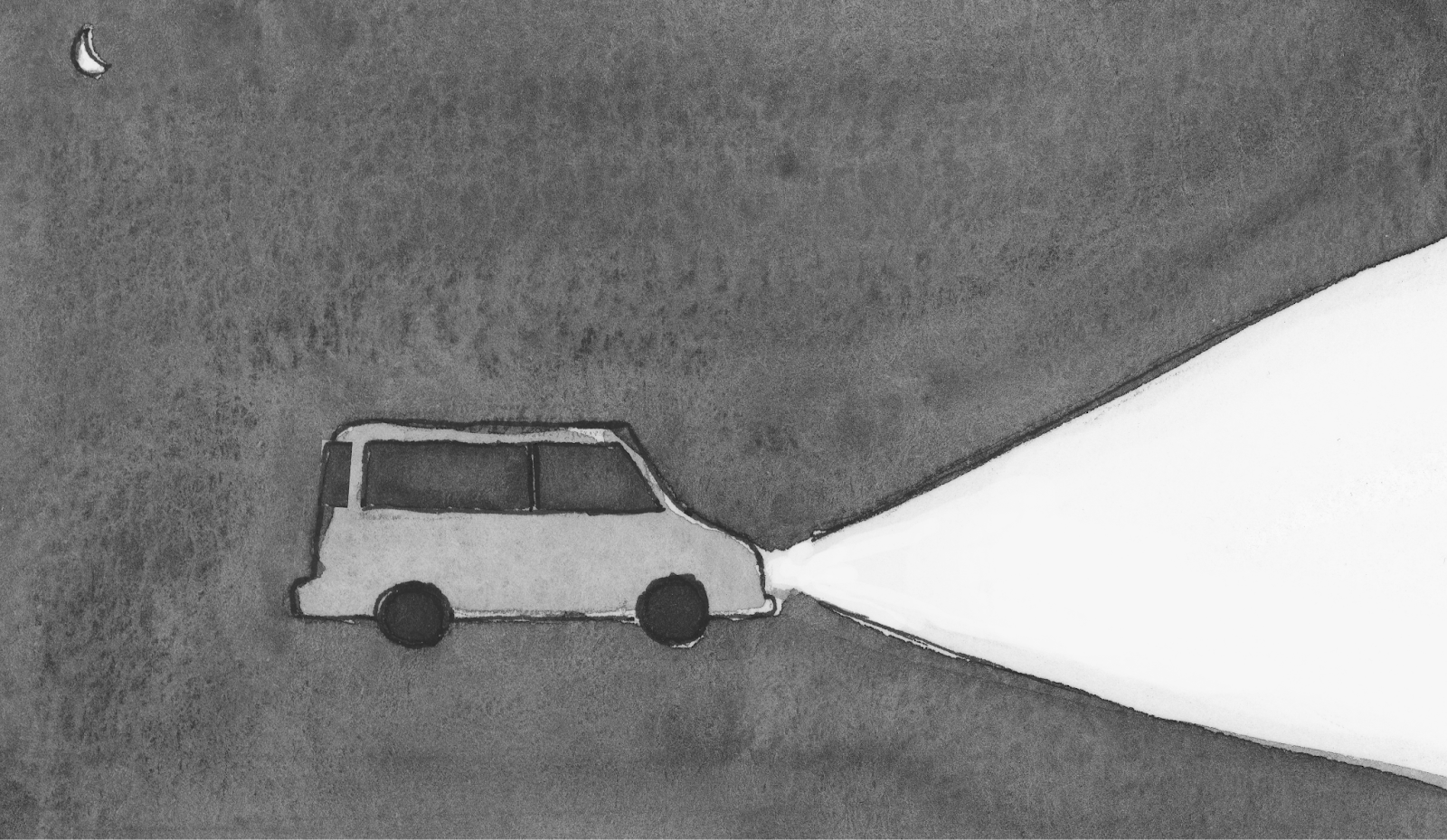
One night, after dropping my mom off at the mall, we were headed back home in the van together. It was dark outside. I must have been about fifteen. We were taking the quieter road back home from the mall. In complete darkness, Nirvana’s Unplugged version of Man Who Sold the World came on the radio. My dad wasn’t much of a fan of the music I liked in high school. I sat wondering when he’d change the station.
Instead, we sat in the dark as the song continued playing. His hand reached forward and to my surprise, over to the volume, turning it up louder. The mournful guitar notes vibrated like a lonesome distress signal, traveling through space. In the van, only the headlights shone brightly in front of us, into the middle of nothing. When the song ended, he gently turned the volume button down and said, “Wow.”
 Shine A Light On Me